Kathmandu
Originally posted 2024-10-02
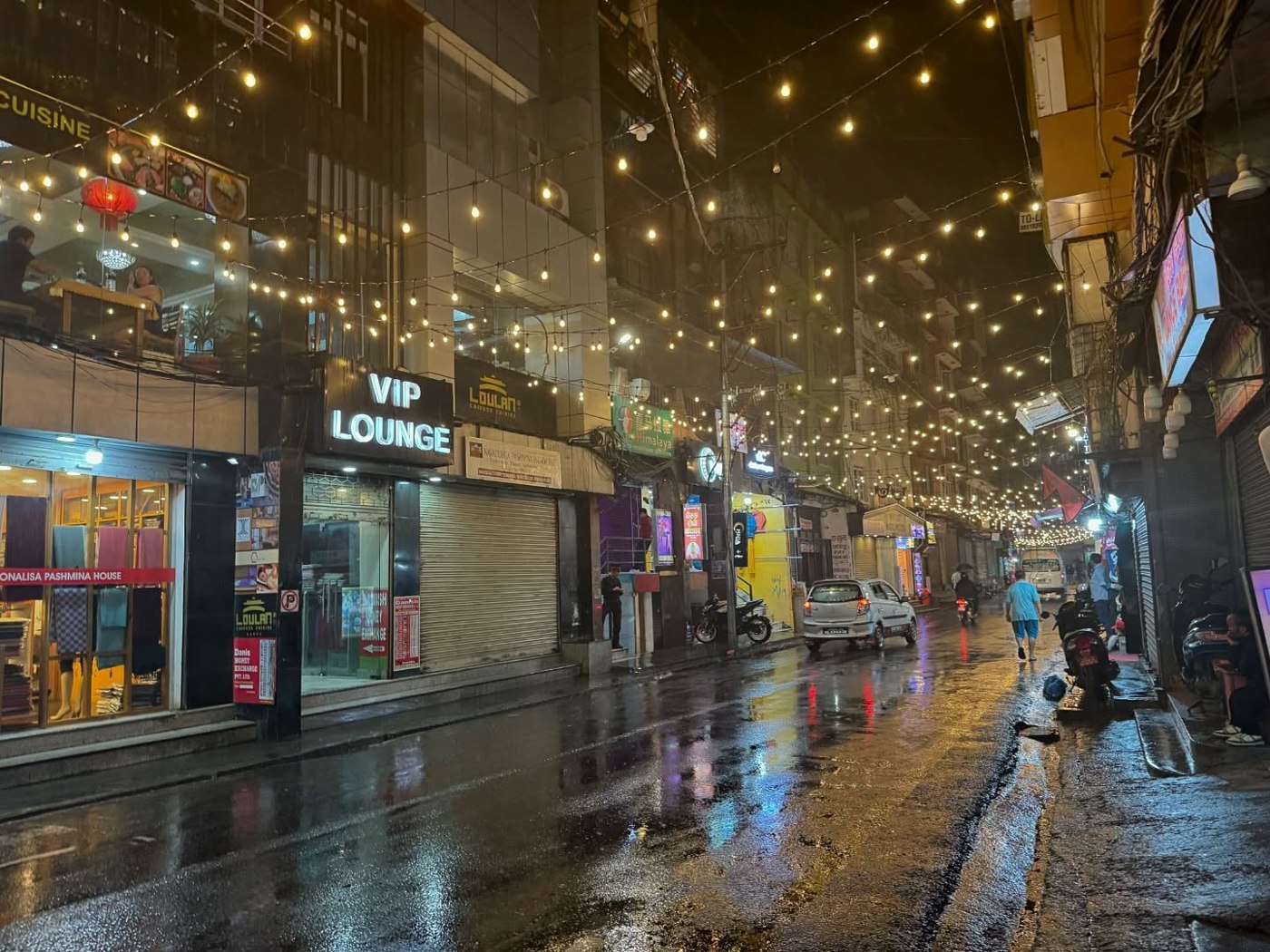
First day in Kathmandu. I flew in at 2am from Dubai and went directly to the hotel and passed out. The next day, the welcome meeting was at 6pm and I woke up a few hours earlier. I had read too much about how the water in Nepal was lethal so I spent a lot of time trying to figure out how to use my Grayl GeoPress on the already filtered water in my room 😂. I also brushed my teeth using filtered water for the first time and it was a very weird experience to not be able to trust the tap. I walked to the mall a few blocks from the hotel which was very underwhelming. I then walked another 20 minutes to a halal Turkish restaurant to eat meat for the last time in the next 14 days - it was incredible! The people on the street were a diverse mix, seemingly evenly split between people with Northern Indian / Pakistani features, whom I would learn were the Hindu ruling class of Nepal, and people with more Far Eastern features, more likely to be Buddhist. At the welcome meeting, the 13 other participants in the trek were mostly 20 and 30 somethings from the UK, all seemingly quite fit, all white, and a few had police or military backgrounds, and most had not undertaken any special preparation for the trek. I thought to myself, this is what life is like when you’re fit, you can just get on a plane and show up to trek to the base of the highest mountain in the world. And then I thought, wait, but I did the same thing, and I’m not fit at all 😂. Over the next few days, my determination would be pushed to the limits as I went through the hardest but also one of the most magical experiences of my life.
Day 1
Originally posted 2024-10-03
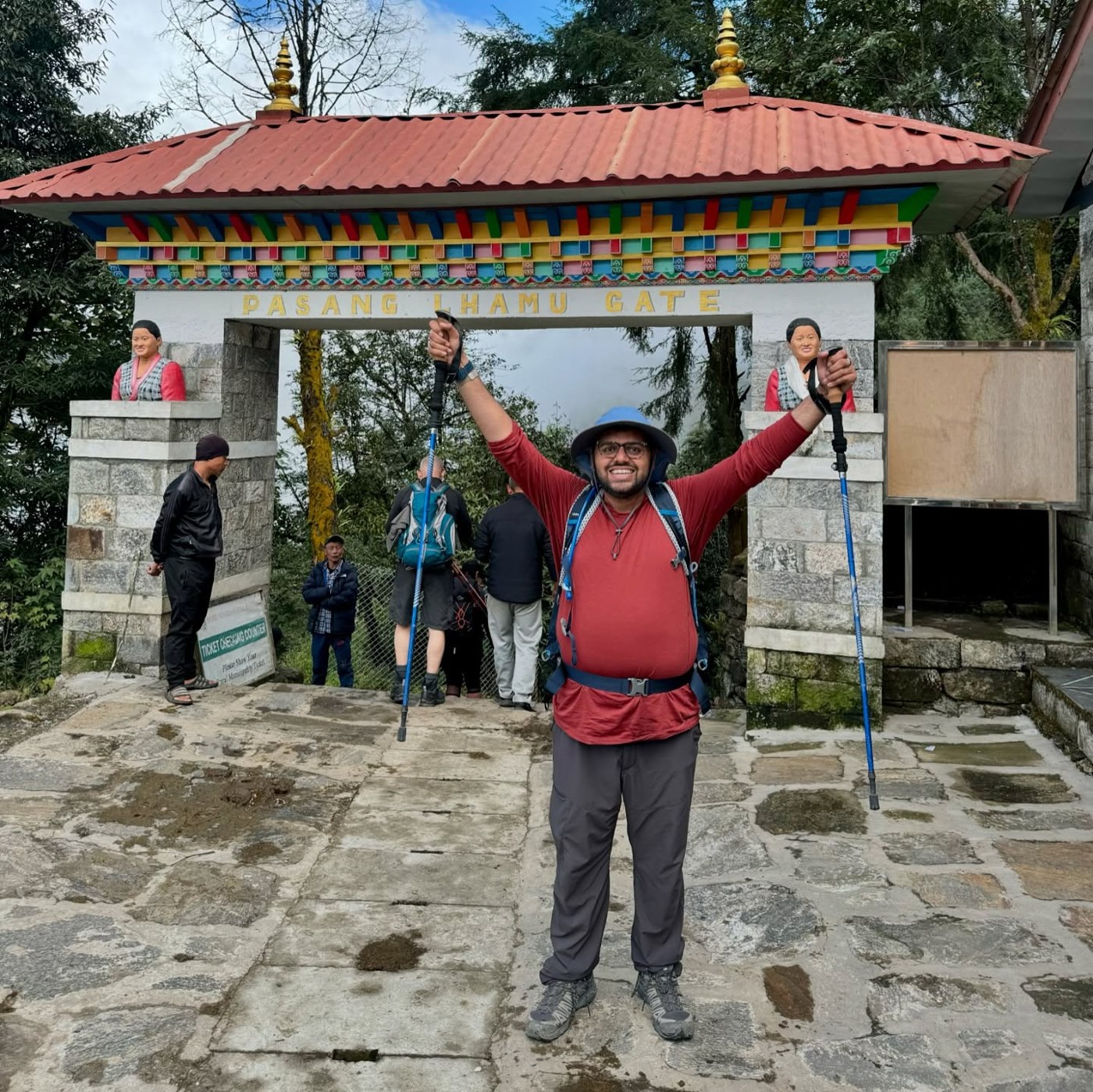
Day 1 of EBC trek begins at 4:30am when we get on a bus to Kathmandu Airport and wait in line with dozens of fellow trekkers with their North Face duffel bags and wait for the airport to open. The main stress of the day is the dreaded weigh-in at the airport; our duffel bags must weigh no more than 10 kgs and our day backpacks must weigh no more than 5 kgs. We are also told to wear all our jackets and carry our water in our hands. Much to my pleasant surprise, I realize the weigh-in is actually a communal one. They put 5 duffel bags on the machine at once and make sure the total is less than 50 kgs. Nice! There is no time to get coffee and we are rushed onto another bus and then onboard the plane. This is the smallest plane I have ever been on and I am thrilled when I am ushered to the front row, just behind the pilots. The flight is terrifying as we thread through canyons with giant mountains all around us; at times, it feels like our clearance over their peaks is just a few hundred feet. We land in Lukla and I see with my own eyes the same view I had seen hundreds of times on the Youtube livestream, which I had religiously tracked to try to time the end of the monsoon season. We have breakfast at a tea house and then the trek begins! Lukla is literally a two block long village, with the airport at one end and the EBC trek at the other end. It is a hot day and my clothes and backpack are uncomfortable and I struggle to keep pace with the group, but quickly find myself at the rear. It is a hot day and the first day of the trek winds through an endless array of villages and shops, heading downhill 1,000 feet. I have so many questions and we meet the animals that will be our constant companions over the next two weeks: horses, mules, donkeys, jhopke (father yak, mother cow), cows, chickens, dogs, and more. I am in awe at the first suspension bridge crossing, and then, by 12:30, we have arrived to Phakding. The first day is a short one and a fairly easy one, yet in my naivete, I will later think it was hard, just like the first day of anything is hard, and also because the trek increases in beauty seemingly exponentially, day over day.
Day 2
Originally posted 2024-10-07
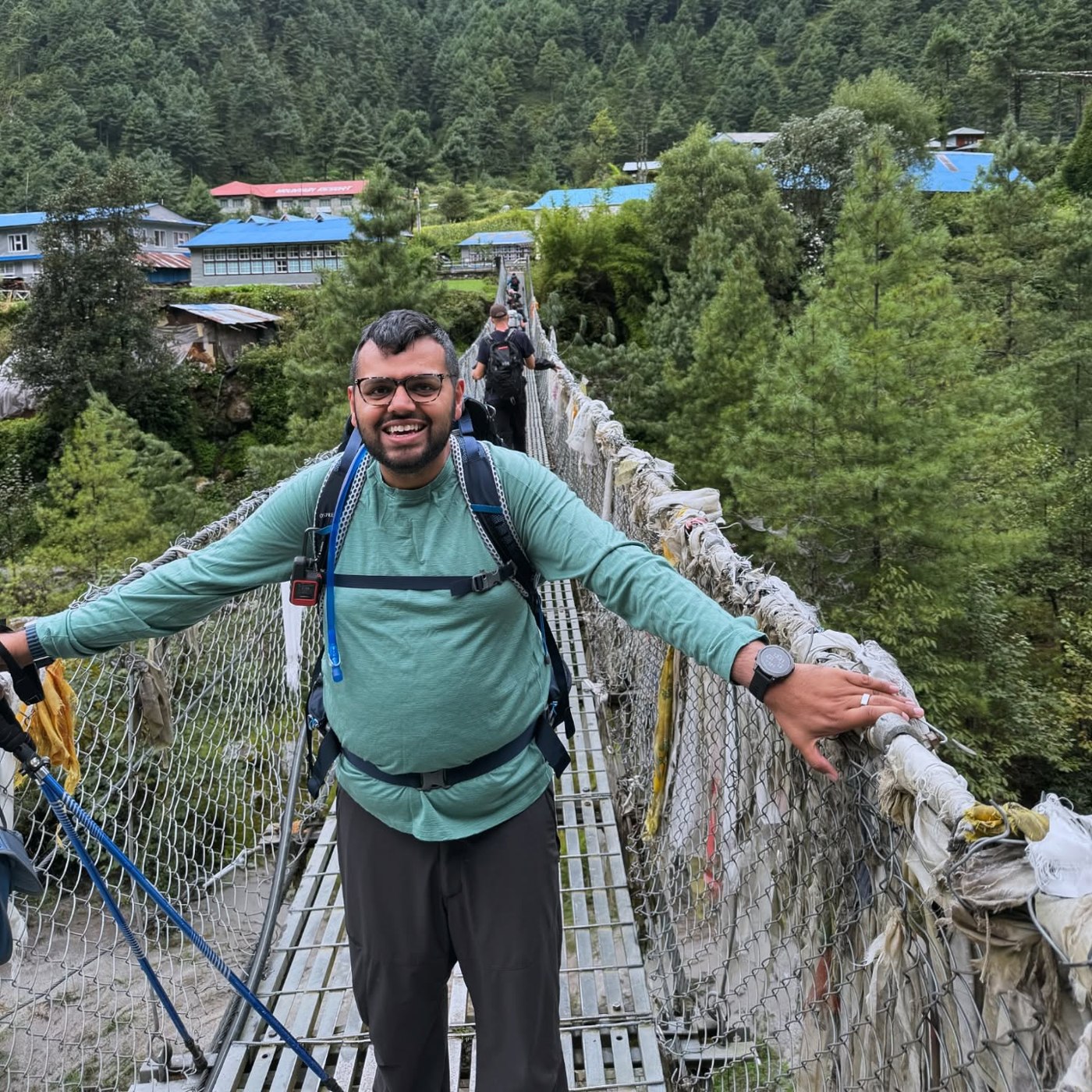
Day 2 of EBC trek is when we walk from Phakding to Namche Bazaar, one of the largest settlements in the Everest region. This is also one of the hardest days of the trek (my Garmin records 3,809 ft of gain and 1,154 ft of descent over 7.8 miles as we end at 11,320 ft.) It’s also a beautiful day, taking us across numerous suspension bridges, past magical waterfalls, deep into alpine forests that could easily be in the US or Europe, and finally, after lunch, up a seemingly endless series of steps that bring us higher and higher, until the final arrival into Namche almost brings us to tears. It’s such a massive and beautiful village that seems to emerge out of nowhere. EBC trek is a time capsule and takes us back to a time when walking was the only way to travel, and you were so grateful to find food and shelter at the end of a long day (which is why hospitality was such a central principle for many premodern societies, because it meant survival). Today was also the first day that our main guide, Gelu Sherpa, sent me ahead 30 minutes before the rest of the group with Dawa Sherpa after lunch to give me a head start and it was such a game changer for my motivation. I was no longer at the back of the pack struggling to keep up but now I was at the front, trying to maintain my lead for as long as possible. At the tea house that night, I met a group of descending Indian hikers. I told them I had heard that the climb to Namche was the hardest part and everything afterwards was easier. They were too kind to disabuse me of my rose colored glasses. I would later realize that EBC gets harder and harder every day, but you also get stronger and stronger every day.
Day 3
Originally posted 2024-10-08
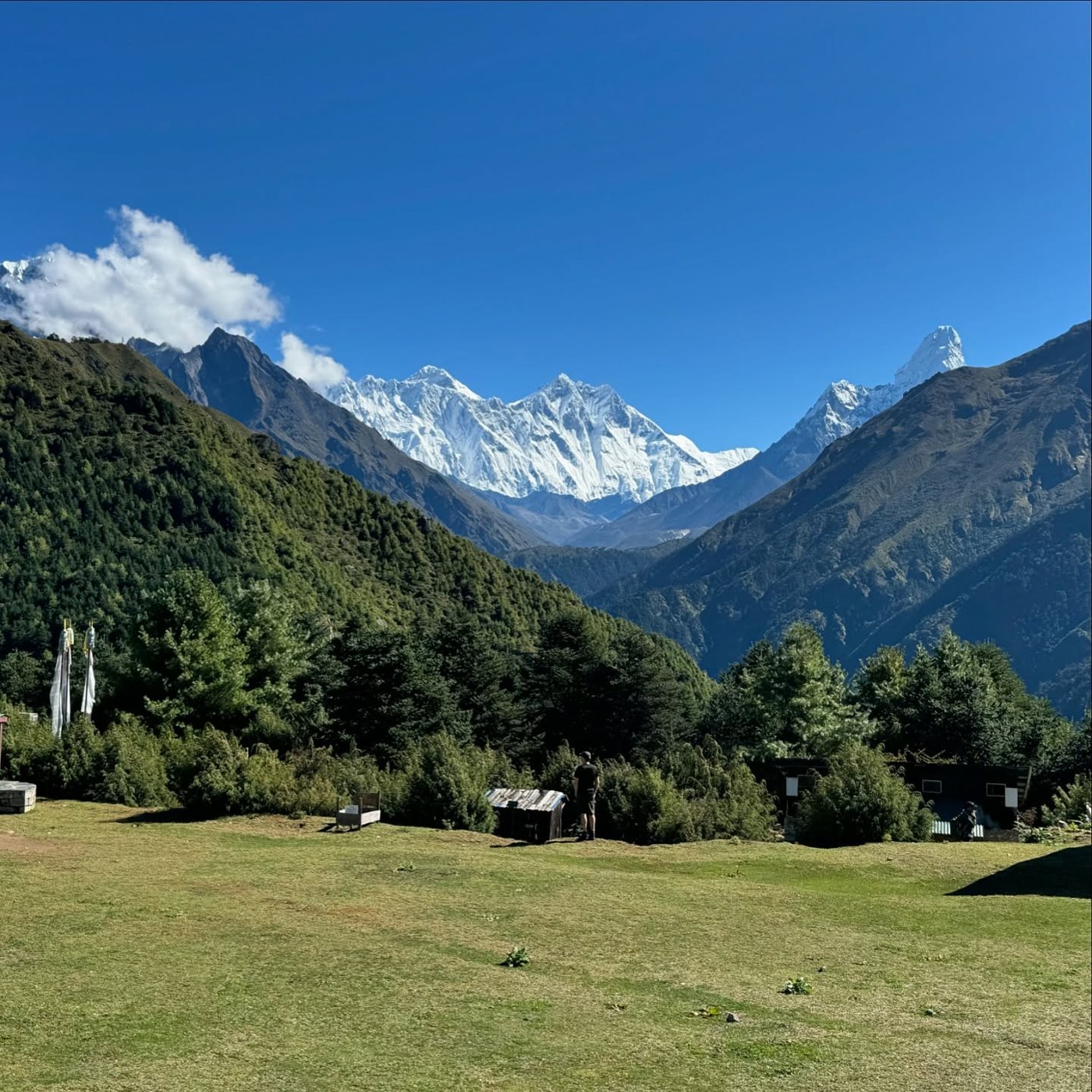
Day 3 of EBC trek is when we get our very first glimpse of Mount Everest, first, from the Tenzing Norgay Memorial Museum just above Namche Bazar, and then from Syangbouche Hill at 12,677 feet, our destination for the day’s acclimatization hike. This is one of the ironies of the EBC trek that Mount Everest is hidden for most of the trek by its neighboring mountains, even at Base Camp itself. Perhaps this is a metaphor for our goals in life as well, we might not see them in front of us with our eyes much of the time, yet we persist in taking one more step, and then another, and another. Today is also when we first see beautiful snow capped mountains all around us, especially the majestic Thamserku (21,680 ft), with its two peaks overlooking Namche Bazaar, which has only been climbed twice in all of recorded history.
Day 4
Originally posted 2024-10-09
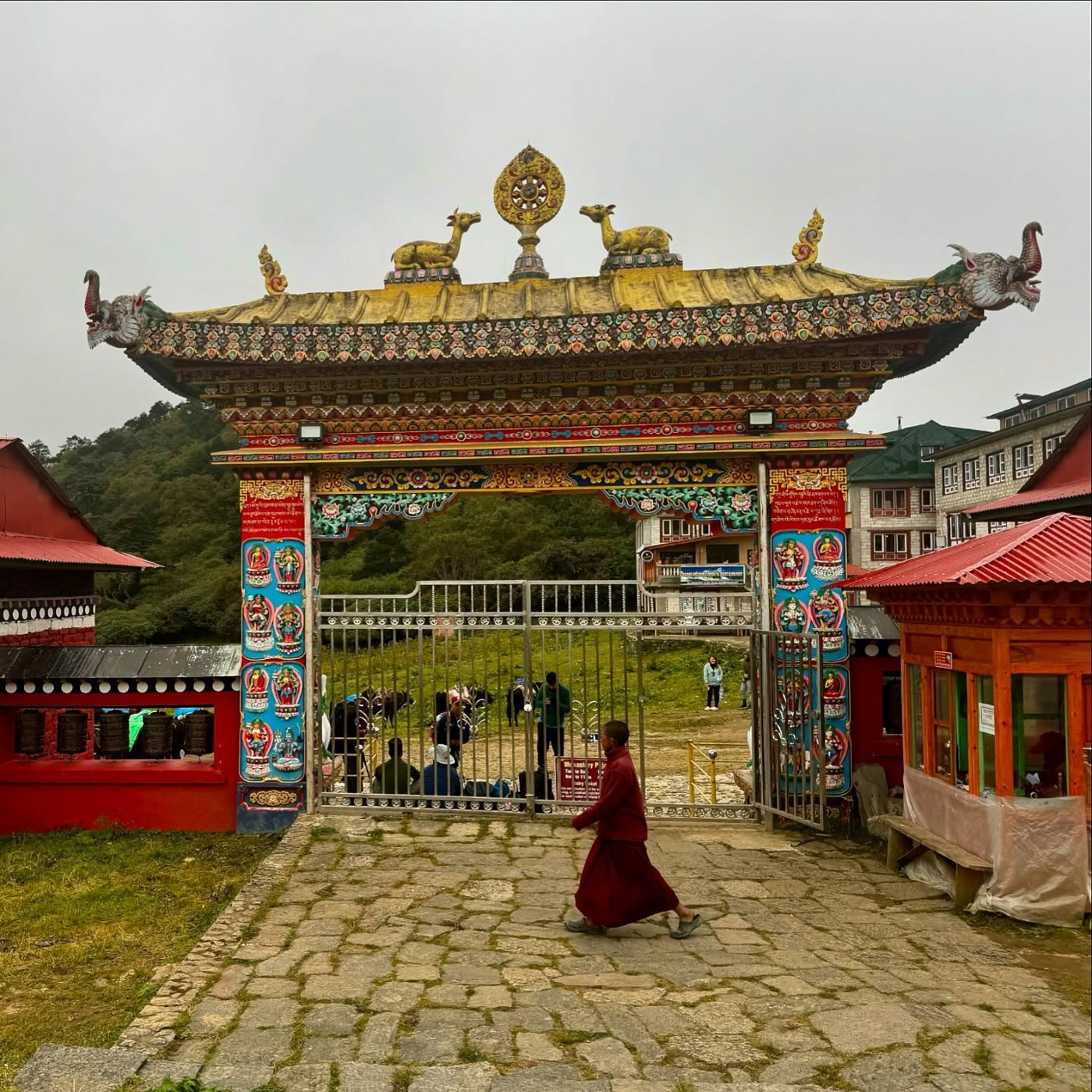
Day 4 of EBC trek takes us out of Namche Bazaar early in the morning, ascending and descending before a relentless 2,000 foot climb through neverending switchbacks and steps that abruptly ends, 7 hours later, at a magical plain covered in the clouds with young monks running around in red robes. We have arrived at Tengboche Monastery at 12,700 feet, one of the holiest sites in Nepali Buddhism. Right out of Namche Bazaar, we pass a local monastery with a sign proclaiming “Gumba In Charge” with a phone number and I am in awe at the connection between the mafia movies of my childhood and what I am seeing thousands of miles away. Later that day, I even see an old monk wearing a robe that says Gumba and I bow my head respectfully. (I would later learn that Gumba just means monastery, oops.) The climb is arduous and I find it much more challenging than the climb to Namche the previous day. I struggle to control my breathing and keep my heart rate low and I start visualizing why I am doing this with every step. (One of the founding principles of self-help is “If the Why is strong enough, the How is easy.”) I imagine my ancestors proudly watching me from above, chatting in Punjabi, “Woh Azhar da puttar Everest de raaste viche hai, chaar din mein pohanch jaaye ga” and it gives me a new wind, but I need more. I imagine my grandchildren talking about my adventures decades later, amused at the exotic names of all the villages I passed on my trek. Namche. Tengbouche. Dingbouche. Lobuche. Gorak Shep. And finally Base Camp Bouche. I am deep in my mind, taking one step at a time, and then, suddenly, we have arrived. The trail abruptly ends and we are now in the clouds. My group is waiting outside the monastery for me to join the tour. We walk inside and I imagine what a pilgrimage must have been like back in the day, trekking for days at a time, and then walking into the sacred site, surrounded by sacred chants, the gongs of bells, eating warm daal chawal. I am so grateful for this trek that takes us out of our artificial 21st century comforts and brings us back hundreds of years to remind us of what the human experience was once like.
Day 5
Originally posted 2024-10-10
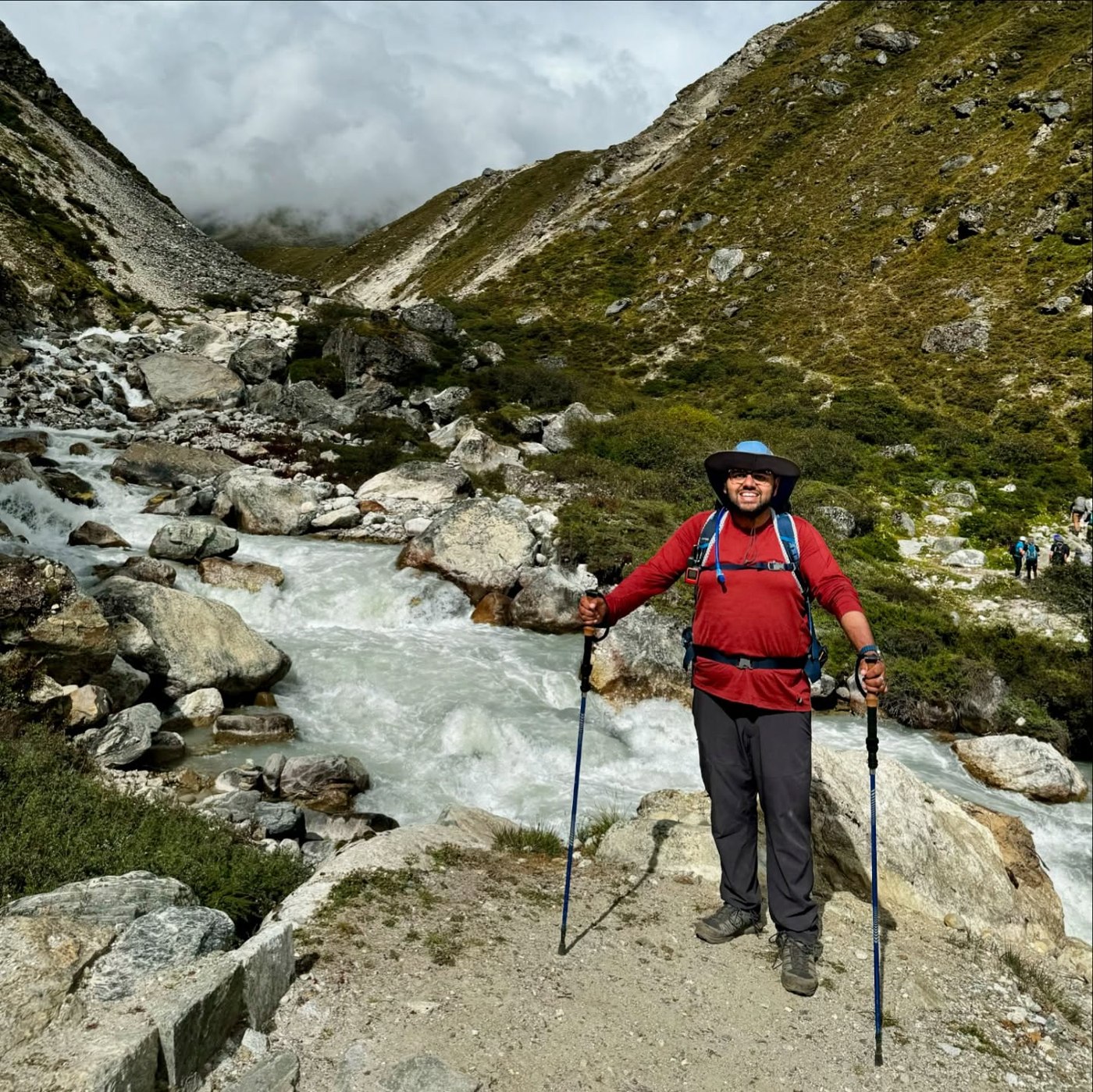
Day 5 of EBC Trek takes us out of Tengbouche early in the morning. We trek downhill through a wooded forest, until we ascend above treeline and follow a narrow trail beside the Dud Koshi River. We cross the river at a junction that looks like a scene from Lord of the Rings and then ascend a zig zag ridge, finally arriving in Dingbouche at 14,100 feet. This is an important day because we are finally well over halfway to Base Camp. Whenever confronted with a daunting objective, the brain sets arbitrary spatial & temporal markers, what psychologists call “thin slicing”, so we tell ourselves “let’s just walk for another day” or “another hour” or even until the next boulder, and this is a critical strategy that helps us get over the finish line. Mountaineering is also magical because so much of it can be seen as a metaphor for life. We trek from Lukla at 9K feet to Base Camp at 17K feet so you might think we ascend 8K feet over the 8 days. But actually, we ascend 15K feet and descend 7K feet over that time. Why? Because there’s no way to get to Base Camp while only going up! Such a trail simply does not exist. So every day you go up some, and you go down some, always going up more than you go down. Eventually you see the descents as both a blessing, because they allow you to catch your breath and get your legs warmed up early in the day, but also a curse, because every foot you lose is one you will need to make up somehow. What a beautiful parable for life. Sometimes the only way to go towards your goal is to go away from it. Over time, this also relaxes you and forces you to trust the trail. I don’t decide if we go up or down today. This is the path God has made that takes us to Base Camp. My job is just to put one foot ahead of the other and keep walking. I once heard a scholar talk about the two life lessons we could all learn from McDonald’s - “I just work here” and “Service with a smile” - and how calming it was to embody these as our ethos. I thought of this often on the trail as I greeted everyone with a cheerful Namaste. “I just walk here.” And as long as I keep walking, before I know it, I’ll be at Mount Everest Base Camp inshaAllah.
Day 6
Originally posted 2024-10-11
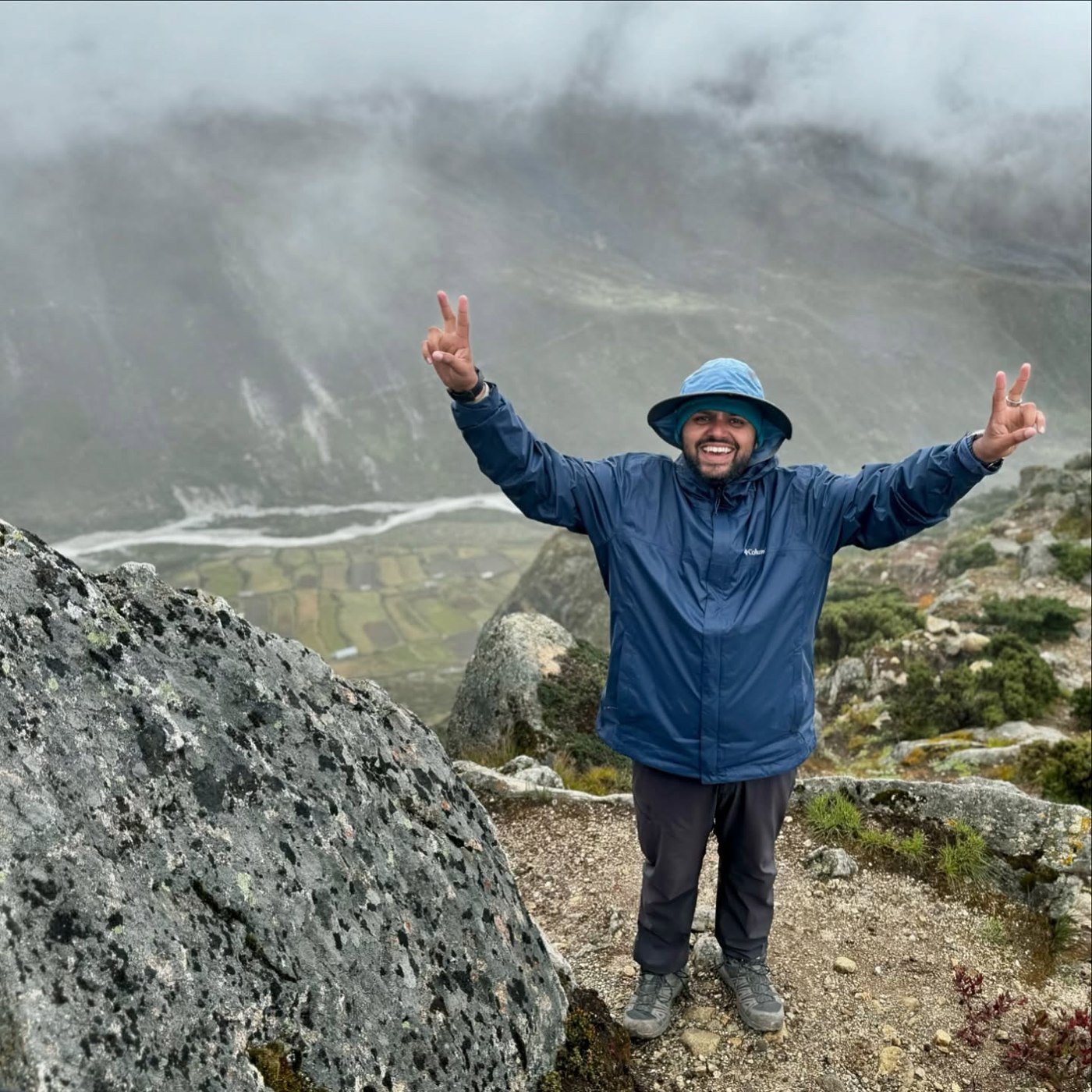
Day 6 of EBC trek is memorable for two reasons: this is the first day it rains, and this is also the day I set a new personal record for elevation, reaching 15,300 feet. (Previously, the highest I had been was Grays Peak in Colorado at 14,278 feet, which I had summited in August.) It is also beginning to get colder, and I find myself sleeping in thermals & two down jackets, holding onto two Nalgene bottles filled with boiled water. That night, it had rained constantly, almost like a sound machine, replacing the sound of dogs barking that had been more common at lower elevations. I also dreamt that the day’s hike had been cancelled due to the rain but I would quickly learn that this was a rain snow or shine type of trek. Today’s hike is an acclimatization climb up Nangkartshang Peak, and it seems like every trekker in Dingboche is climbing this mountain today. Every few hundred feet has a cairn of stones and a set of Buddhist prayer flags that we pass, one after the other, until we stop halfway up the peak (a handful of our group continue to the actual summit, but most of us conserve our energy for the last 2 days of the ascent). We are down by 2pm and we discover a delightful & modern cafe and bakery next to our tea house. I have a brownie as we watch the daily film screening - 14 Peaks with Nims Purja. Suddenly, our guide comes in telling everyone to go outside. The clouds have cleared and Ama Dablam, the 22,000 foot peak, is visible overlooking the village. I also take pictures of yaks. Two more days to Base Camp. Let’s do this.
Day 7
Originally posted 2024-10-13
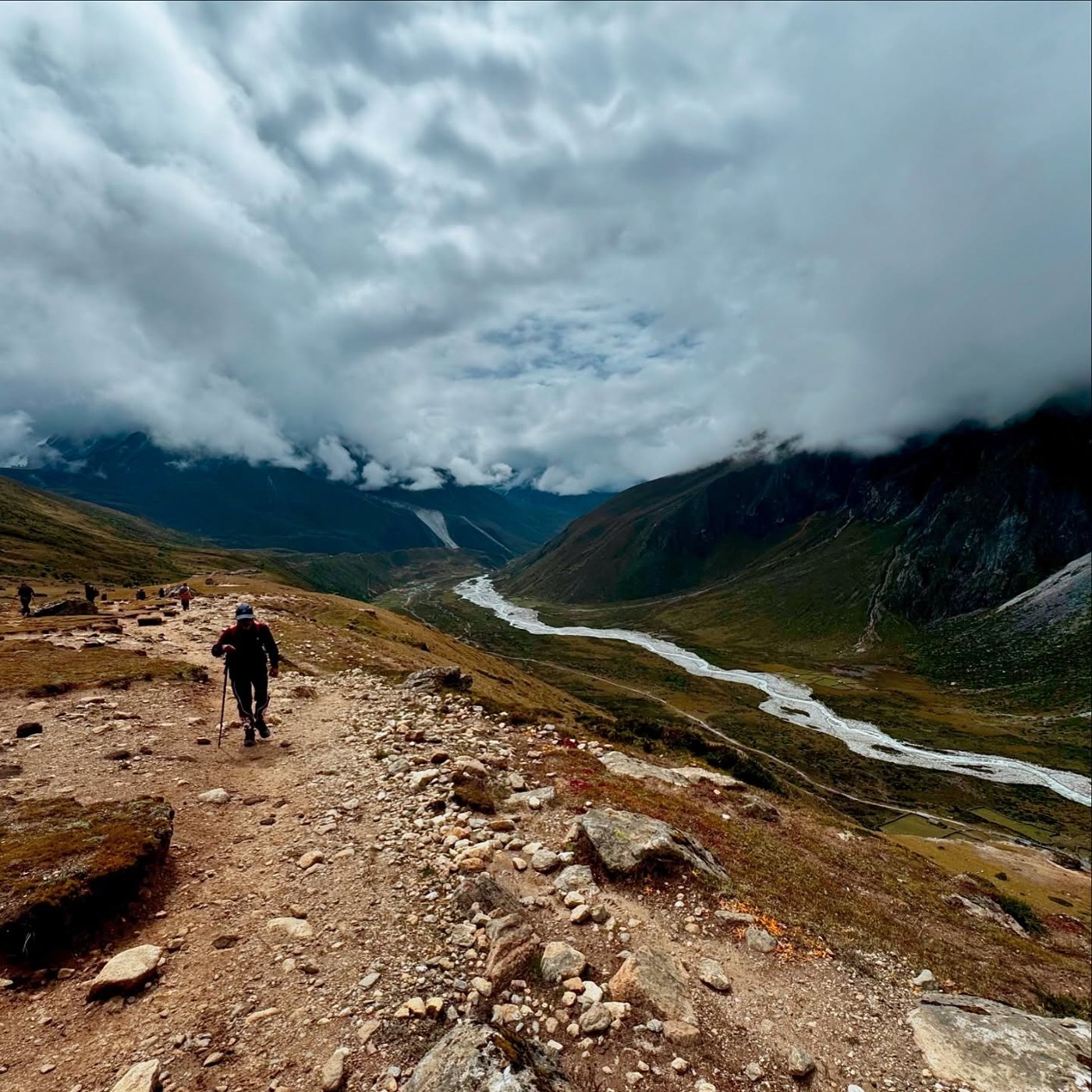
Day 7 of EBC trek is one of the most difficult as we ascend 2,300 feet to arrive in Lobuche at 16,200 feet. It’s cold & rainy, and the initial ascent out of Dingbouche gives way to a large plain that we traverse for three hours, until we descend a bit, cross some violent rapids, and then ascend again to arrive for lunch at Dughla. I am filled with excitement but also scared & exhausted. In the hall, I spot a Saudi flag signed by Abdullah Al-Hamdan & I take it as a good omen. If one Hamdan made it, surely this one can too. Upon leaving Dughla, we are confronted with a steep, massive, & seemingly endless boulder field. We are higher than 15,000 feet and this is the steepest ascent left until Base Camp. I gasp for breath with every step. Step, break, two breaths in, one big breath out, make sure my heart rate is less than 130, repeat. A Nepali cowboy astride a beautiful white horse speaks to my guide. I imagine him saying, “This guy looks rocked, he will never make it, let him take the horse.” This horse shuttle service is ubiquitous during the last two days, charging exhausted trekkers hundreds of dollars to go the last few miles. But if God brought me here on my own two feet, how could I give up the last few steps? “Hum paidal jaaein ge,” I respond forcefully, and my guide & the cowboy both laugh. Later on, we encounter a heavyset British man, stumbling up the boulder field, his guides holding each arm. I find a new wind of energy as I encourage my new companion. “We’re almost there, mate, one step at a time, I’ll split a Bounty with you at the top.” He laughs, “Is there an ice cream truck up there too?” Up there is something far more serene, a massive plain covered in clouds containing a memorial dedicated to mountaineers who gave their lives in the Himalayas. A few minutes later, I am splitting a Bounty with Simon, and he looks to be near tears. “You’re a true gent,” he says, as he hugs me. All pretense falls away in the mountains. They are the great equalizer and every man is alone, but we are also one, as we strive to reach new heights and come face to face with the limits of our abilities. An hour later, we are in Lobuche. Tomorrow, we will be at Base Camp.
Day 8
Originally posted 2024-10-14
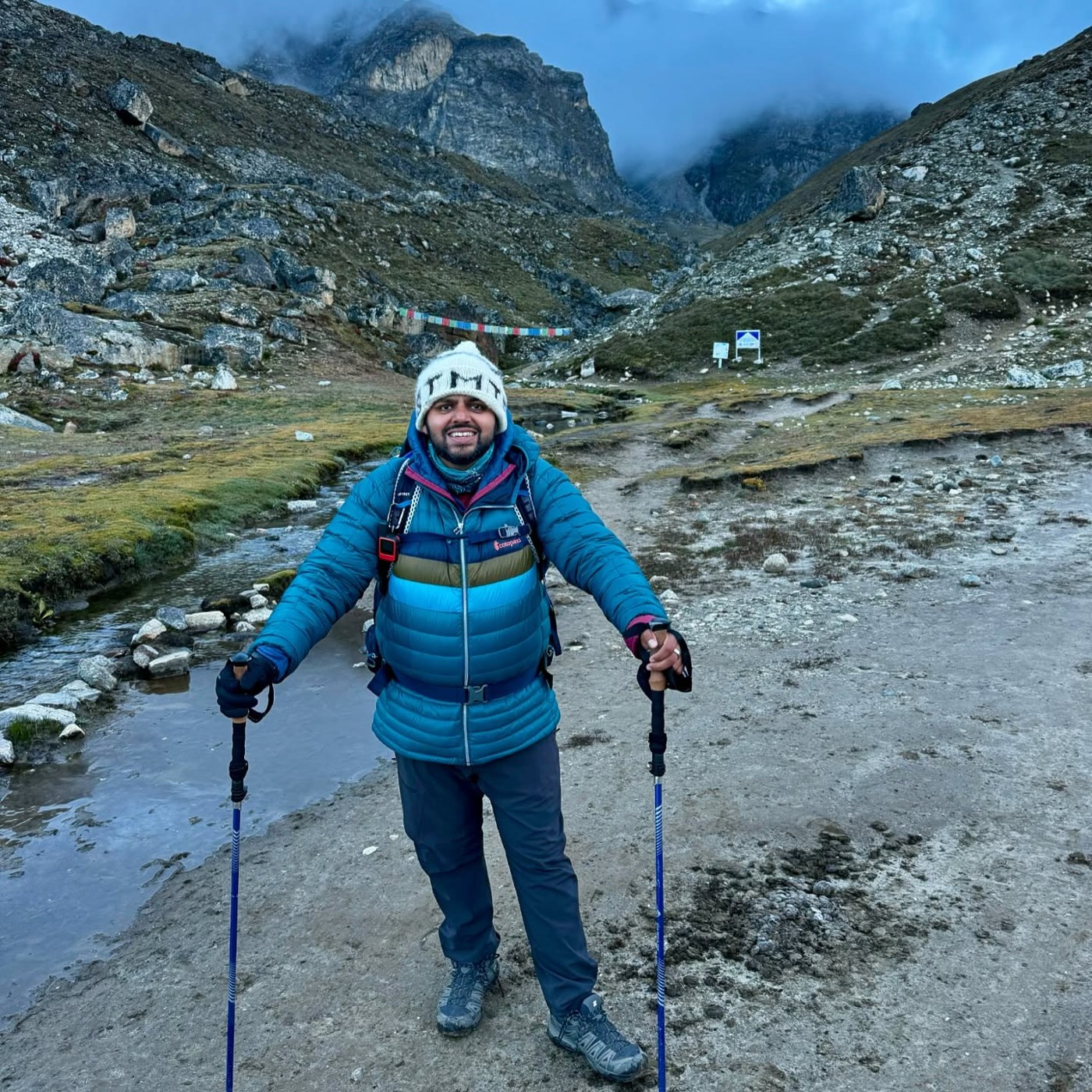
Day 8 is the highlight of EBC trek. This is the day we reach Base Camp. The night before, I get a stern lecture from our master guide, Gelu Sherpa. Every day, his goal is that I start 30-60 minutes before the rest of the trekkers in our group. This head start ensures that I finish within 30-60 minutes of the others. But to Gelu Ji’s consternation, I am often late (story of my life). But now he tells me “If you are late tomorrow, you will miss Base Camp.” I know this is my last chance to redeem myself. The next day, I set my alarm for 4am, wake up, pray, gulp down coffee with porridge, and I’m on the trail by 5am, accompanied by junior guide Dawa Sherpa. This will be one of the most magical days of my entire life. (If I had to complete the entire trek with no views at all except the views of Day 8, I would still do so in a heartbeat.) As we pass 16,000 feet, it is as if we have entered another dimension. We are surrounded by snow capped peaks in all directions. We get to watch the sun rise above Mount Pumori, then reflect off of Mount Nuptse & Mount Lhotse, and we see Mount Everest itself, a small triangle eclipsed by its neighbors. Today, we trek 4 hours from Lobuche to Gorak Shep, then have an early lunch, and then trek the final 2.5 hours to Base Camp before returning to Gorak Shep for the night. These pictures are all from the trek from Lobuche to Gorak Shep which is one of the most beautiful sections of any trail I have ever hiked in my life. The weather is freezing when we start at 5am, and I am bundled up in thermals & two down jackets, but the skies are clear, and once the sun rises, a certain euphoria sets in that is hard to describe. At one point, the elevation perturbs my stomach, and I grab some toilet paper and scramble up a nearby ridge. After completing my business, I see Conor, a trekker from another group, climbing the same ridge & approaching me. “I saw you come here to see the sunrise and I figured I’d do the same.” Yes, exactly, what a beautiful sunrise, I grin & nod, while silently praying “Please don’t look down.” We arrive at Gorak Shep at 9:30am. We are at 16,864 feet and Base Camp is just 2 miles away. We might as well be on Cloud 9.
The final two hours to Base Camp
Originally posted 2024-10-15
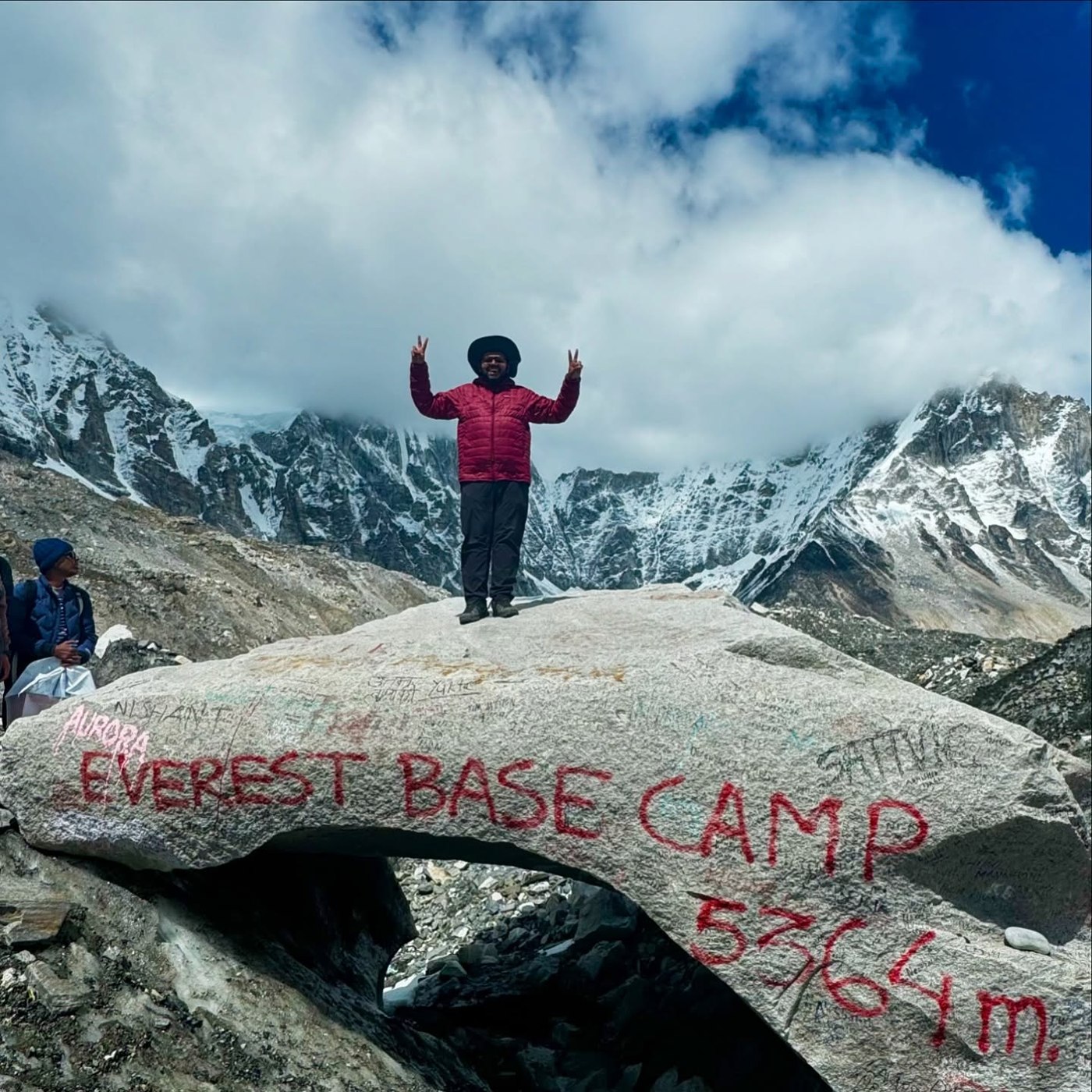
The final two hours to Everest Base Camp feel like a dream. The trail is fairly mild, with occasional scrambles to cross glacial melt rivers to keep us on our toes. On this day, our porters carry our daypacks for us as well, and without the weight, it feels as if we float above the clouds, walking on the Khumbu Glacier, being carried towards our destination by the rivers of inevitability. The final approach involves a steep & narrow descent along a trail lined with beautiful horses. A horse shuttle service runs from Gorak Shep to Base Camp, tempting exhausted trekkers to take a horse for the home stretch for $300. I have so much strength in the face of this final temptation that it scares me. “If God brought me here walking 8 days on my own 2 feet, I can walk 2 more hours.” Base Camp itself is a collection of rocks, surrounded on all sides by glacial walls, with the classic sign scrawled on a giant boulder, as well as a new sign that has tipped over already. It feels like a reunion & the weather is perfect; we all congratulate each other and take pictures. Just a month earlier, I stood at 14,000 feet for the first time, twice, in Colorado, and now, by the grace of God and with the support of an incredible team of guides and porters, I stand at 17,500 feet, face to face with the tallest mountain on Earth. I think to myself that I have been the slowest person in my group, but if I have a choice between being the slowest person on a treadmill in New York, or the slowest person trekking to Mount Everest, why not pick the latter? One of the ironies of Base Camp is that from there, you cannot see Everest at all, since it’s eclipsed by its neighbor, Lhotse. But the purpose of this trek, I realize, wasn’t to look at Mount Everest, but to look at myself, to forge a new identity, to make myself and my loved ones proud. As we return, that steep final descent has now become an ascent, but the euphoria of having reached our destination carries us forward. 2 hours later, I am back in the dining room of our tea house in Gorak Shep. I was so anxious to get to Base Camp but now I realize how much I will miss this magical place. Alhamdulillah, God is truly great ❤️
After Base Camp
Originally posted 2024-10-17
After reaching Base Camp, despite the euphoria, it felt like parts of my body began shutting down. My throat felt like it was on fire, parched & torn after days of gasping for breath at high altitude. My nose was constantly running. My lips were completely sunburned because I had forgotten to apply lip sunscreen. The primary agenda for Day 9 was an 8 miles hike with an aggressive 3,000 feet descent back down to 14,000 feet. There was also an optional 3:45am hike up to Kala Pathar at 18,500 feet. I had always fantasized about the hike which was supposed to offer the best views of Everest. I even woke up at 3:30am but my body was so sore and my throat was screaming and it was also freezing and raining so I went back to sleep, but not before taking an eerie picture of headlights snaking up the mountain. (Only 1 person in our group went up and she said it was snowing at the top.) The initial descent that morning was up and down several passes, one of which was especially narrow and steep with a long queue of trekkers that reminded me of the famous Hillary Step picture. Initially, I wore my balaclava to cover my mouth to force warm air back into my throat, but it became too uncomfortable. We also retraced all of our steps, and it was wild to experience the same trail after having reached Base Camp. The descent after Everest Memorial Pass that had seemed so brutal on the ascent was now conquered in just 20 minutes. Although we were exhausted, the joy of being on our return trip and being able to breathe easier with every step as we descended made up for our weakness. We reached Pheriche at 5pm and eagerly connected to the internet. Now we counted down the days before we would be back in civilization, with equal parts excitement & regret.
Day 10
Originally posted 2024-10-19
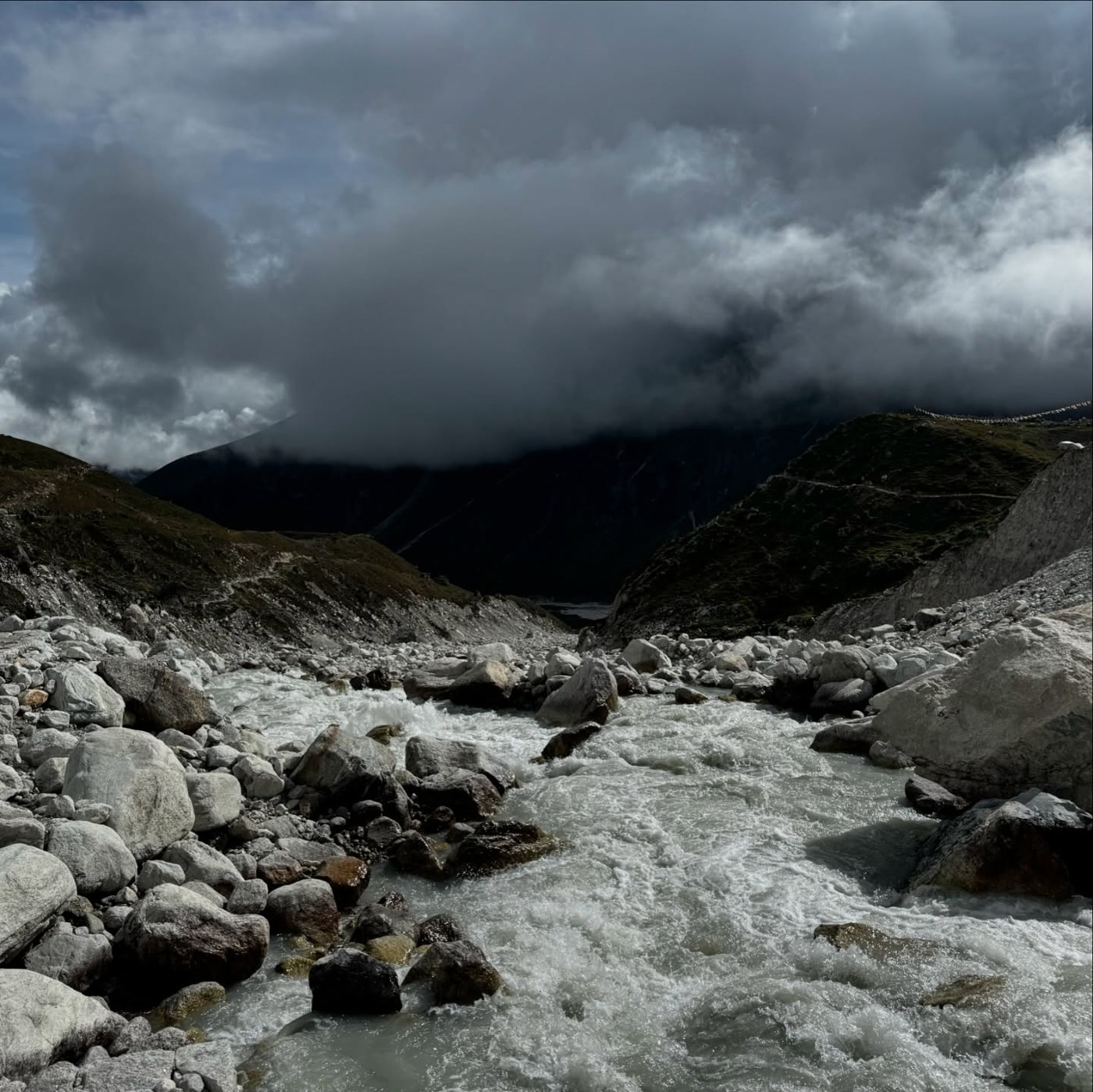
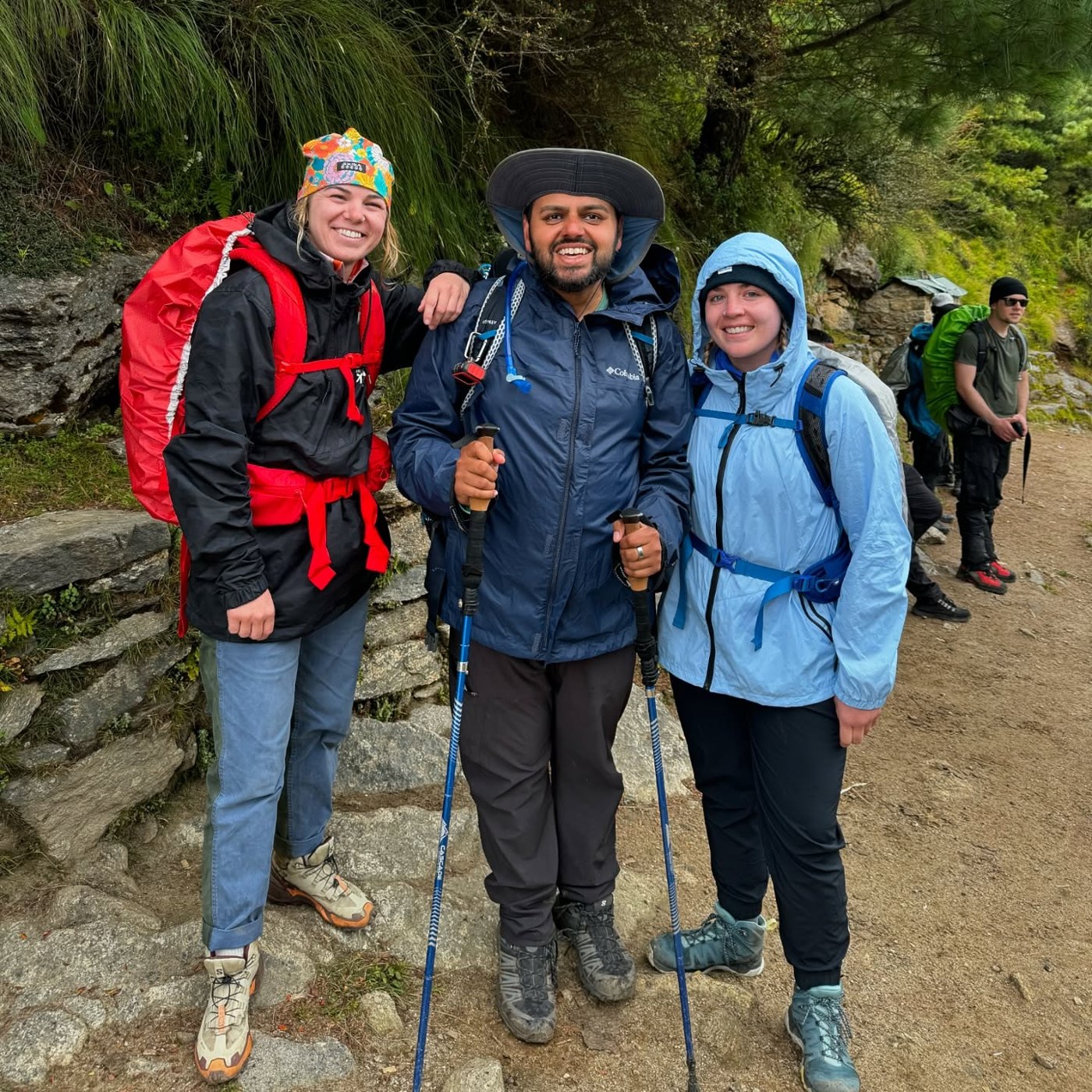
On Day 10, we hike from Pheriche to Kyangjuma, more than 10 miles over 8 hours including 4,000 feet of descent and 2,000 feet of ascent. The last ascent is especially brutal as a light drizzle starts that quickly intensifies into full blown rain. In some respects, I think that the descent is even harder than the ascent, perhaps because returning home is not nearly as compelling an objective as reaching Mount Everest Base Camp. The mindset of “I can’t wait to be on top of the world” has given way to “Wow we did it now get me out of here.” Towards the end of the day, I reunite with another group of trekkers whose paths keep crossing with ours over the trek. Two young women from Colorado who tell me, to my shock, that they have never hiked a 14er. Conor, the young British hiker whom I had run into memorably on the ridge at 16,000 feet, an entrepreneur from India, and a Cuban trekker from Miami who tells me my Spanish accent is as native as it gets. This is one of the magical things about EBC trek - it is the most multicultural trek I have ever been on, and over the 12 days, I found myself speaking no less than 10 languages (English, Nepali, Tibetan, Hindi, Spanish, French, German, Russian, Korean, & Malay). Nevertheless, I was the only Pakistani I encountered, and my guide also told me I was the first Pakistani friend he had made over his 25 years leading this trek. I was also the only Muslim I met except for a small group of Malaysians, proudly carrying their flag and wearing hijabs, with whom I excitedly exchanged salaams.
Days 11 and 12
Originally posted 2024-10-20
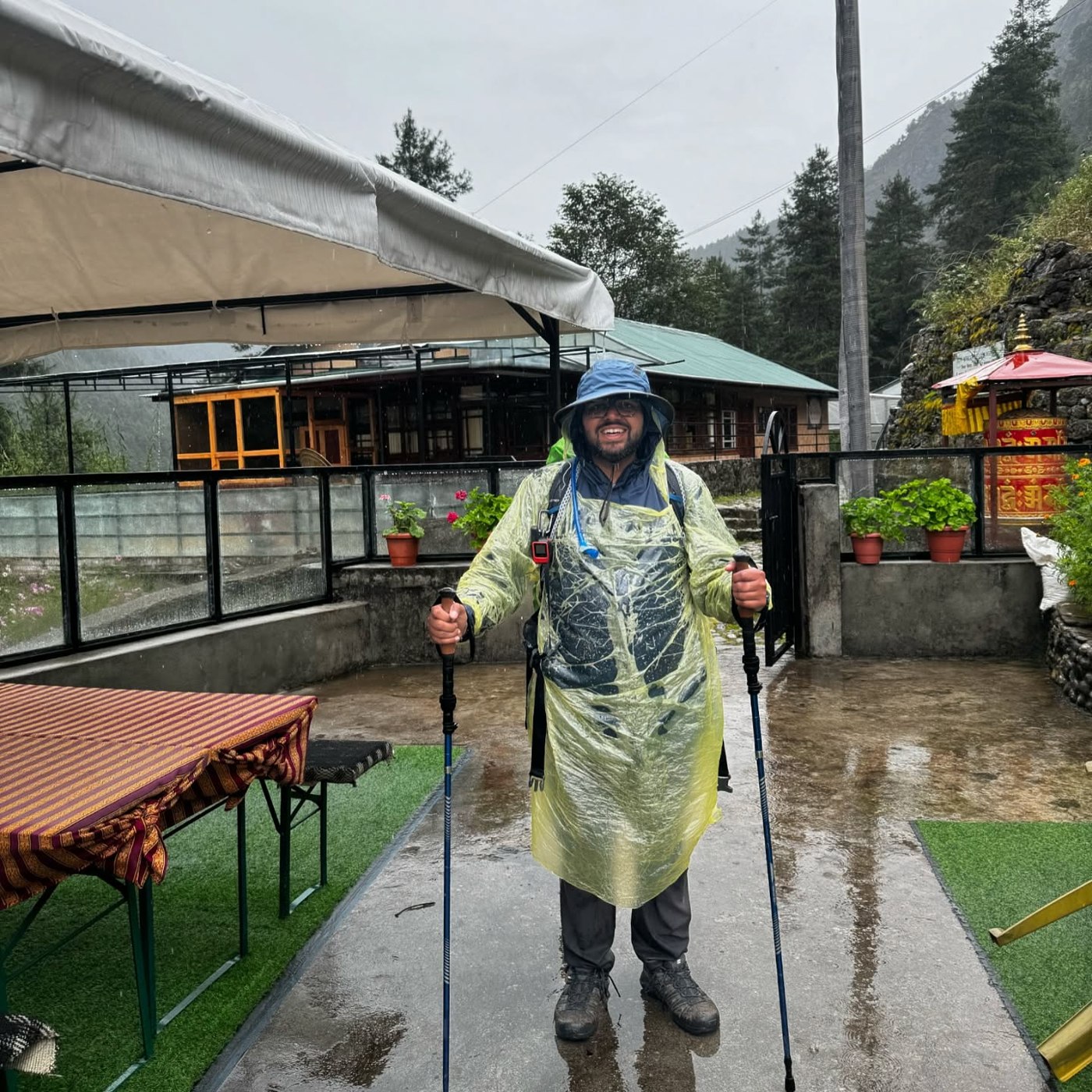
The last two days of EBC trek, Days 11 & 12, we encounter nonstop rain, and despite wearing waterproof rain jackets & ponchos, we find ourselves drenched to the core as we descend 5,400 feet and ascend 2,900 feet over the final 16 miles of the trek. By now, we are so close to the finish line, we have no room for fantasies of helicopter rescues, we just have to keep putting one foot ahead of the other, and soon, we shall be champions for the rest of our lives. We pass through Namche Bazaar again where I have the best pizza of my life. I realize there’s a blessing to an out and back trek where you retrace your steps because at every stage, you get to see old sights with new eyes, and compare how exhausted and scared you felt in the exact same place just a week earlier, and now you feel exhausted and relieved, buoyed by the satisfaction of accomplishment. The final few hours are especially brutal since it’s all ascent and I have never been so thoroughly drenched in my life for 2 days nonstop (while hiking!) Tony Robbins teaches that one of the most important secrets to contentment is being able to find an empowering meaning in any situation. I reach deep into the cookie jar and tell myself, “God is putting you through this rain storm to make you stronger than you have ever been, and to teach you that after you achieve incredible successes, everything does not magically become easier. Sometimes, things become even harder, and you persist because YOU have become even stronger.” When we arrive in Lukla, we find a village completely cut off from the outside world. No internet, no cell service, and days later, we will learn that this is the worst monsoon to hit Nepal in a century, and hundreds of people have died in landslides and floods throughout the country. Alhamdulillah, God sees fit to protect us from that reality for a little bit as I stumble into our final teahouse, kick off my shoes, take my first hot shower in days, and fall to the floor in tears in gratitude to God for this unforgettable adventure and for all of the countless blessings of this magical journey.
Leaving Lukla
Originally posted 2024-10-30
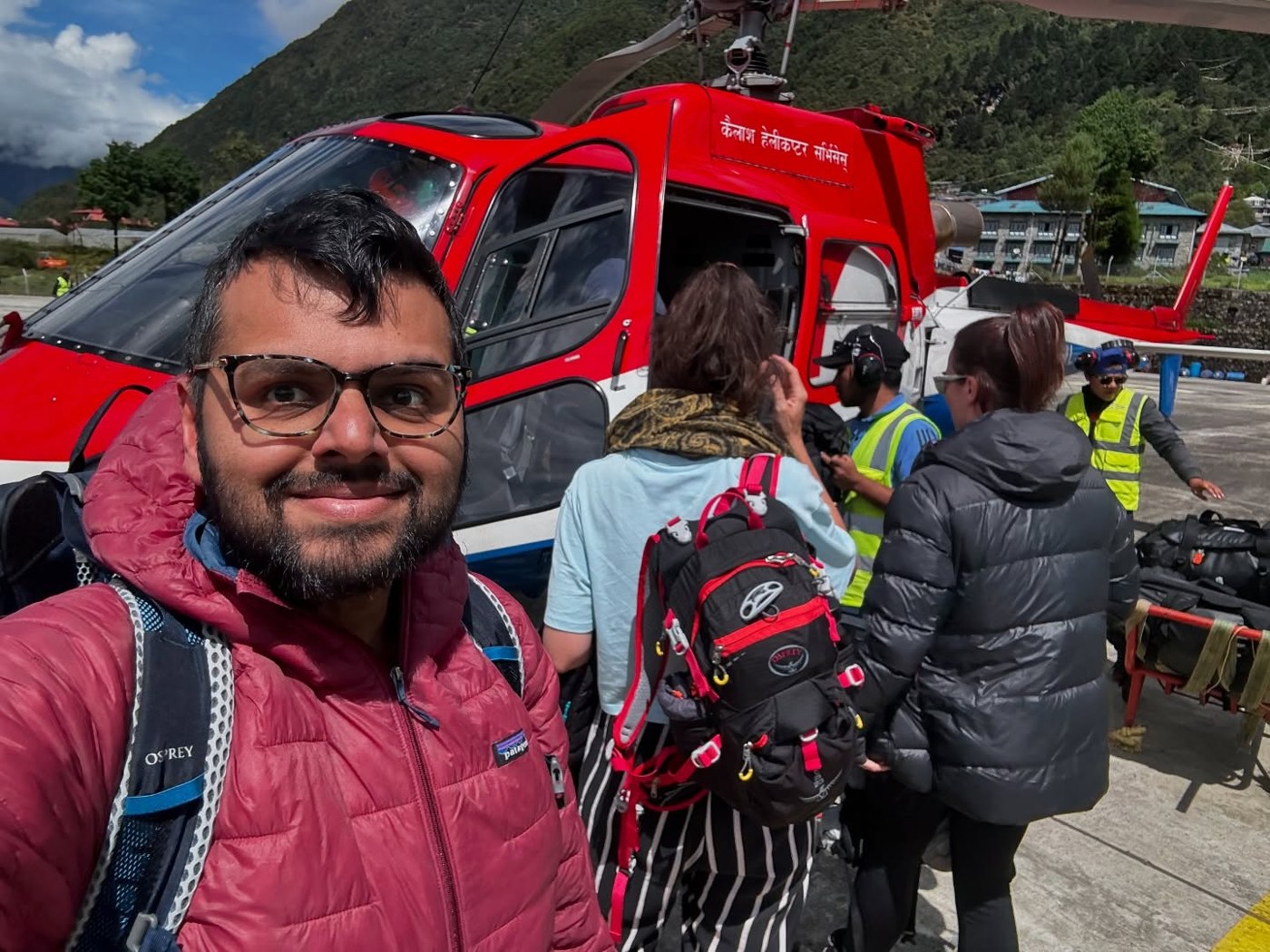
We arrive in Lukla on Friday afternoon, having planned to fly back to Kathmandu the next morning. However, the rains have intensified and not only is the airspace shut down, but the worst monsoons in over a century have left hundreds dead, bridges are destroyed, and there is no cell or phone service in town. Nevertheless, hope springs eternal, and we are asked to be ready at 6am Saturday morning, but when we wake up, we can hear that the thundering rains have not lessened in the least. I sleep in that morning for the first time in two weeks and wake up and have a late breakfast and discover a cafe serving Baskin Robbins next door. That night, Gelu Sherpa informs us that the weather might clear the following morning, but since the flights have been backlogged for three days now, he will try to get us evacuated by helicopter. We have a group meeting and everyone is ranked according to how urgently they need to get back. Since I haven’t booked my return flight from Kathmandu yet, the group votes to assign me to Group 3, the lowest priority chopper. The next morning, we wake up at 8am, and spend 4 hours waiting, as Groups 1 & 2 are collected and walked over to the helipad. Finally, just before noon, Pemba Sherpa runs into the lounge, announces “Jaam Jaam” for the last time, and we walk over to the helipad. The flight from Lukla to Kathmandu is even more wild by helicopter than it had been by plane, as we weave through clouds & narrow mountain passes, before finally landing in Kathmandu, thereby officially bringing our Everest Base Camp trek to an end.